
By: Kathryn Kulie, UW-Madison iSchool
If you’ve been on the internet for a long time, or if you’re a diehard fan of “The Far Side” comics, you’ve probably heard of Gary Larson’s 1982 single-panel cartoon, simply captioned “Cow tools.” Stay with me, here. A cow stands on the left side of the panel, looking at a low table in front of it. A barn is visible in the background. In the foreground, four shoddily made tools sit on the table, one of which appears to be some sort of handsaw. The other three are vaguely familiar looking, but one struggles to place the corresponding real-world tools.
This cartoon quickly grew to be one of Larson’s most well-known and “loathed” creations. According to The Spokesman-Review, its publication “provoked a deluge of calls to newspaper editors across the country” from confused readers who wanted to get in on the joke. This widespread outcry was so great that it eventually forced Larson to publish a press release explaining the logic, or lack thereof, behind the cartoon. But what would happen if its creator never explained this “exercise in silliness”? What would happen, say, if you were to come across this image in an archival collection and had no other information to work with beyond the creator’s signature in the top left?
In the previous paragraph, I’ve actually already done most of the work needed to create a description for this item in a metadata record — in a few sentences, I’ve detailed the cow, the barn, the tools, and the caption, as well as their locations in the image. Nevertheless, the result would be a frustratingly vague description. What are the tools? Why are they being used, and in what context? To go even further, we could ask: Who is the cow? Where is the barn?
If we’re lucky, we might find Gary Larson’s illustrious record as a cartoonist with just a bit of light research (or, just as possible in this hypothetical world, we might not find anything about the creator). Simply put, the archivist tasked with creating a metadata record for this item is in a tricky position, albeit one that is common for local cultural heritage institutions that may not have extensive information about the materials in their care.
As I worked with Northcentral Technical College’s archival collection of photographs this summer in Wausau, I encountered a variety of my own Cow tools-esque images that provoked similar frustrations. NTC’s photograph collection spans from the school’s opening in the early 1910s, when it was called the Wausau Vocational School, to the late 90s, when it was already using its current name.
Over the years, the school has offered a wide range of academic programs spanning nearly every industry and trade one might think of. As such, photographs of students welding cars, painting tractors, performing x-ray imaging, and calibrating laser systems, among many other things, are a core part of NTC’s collection. They do a wonderful job of capturing what students were learning in their programs, as well as what processes (and yes, what tools) they used in their work over the years. However, I am not a welder, nor have I operated a laser system, which means that pictures like the one below are, to me, not so different from our titular Cow tools cartoon.
How would you describe this image?
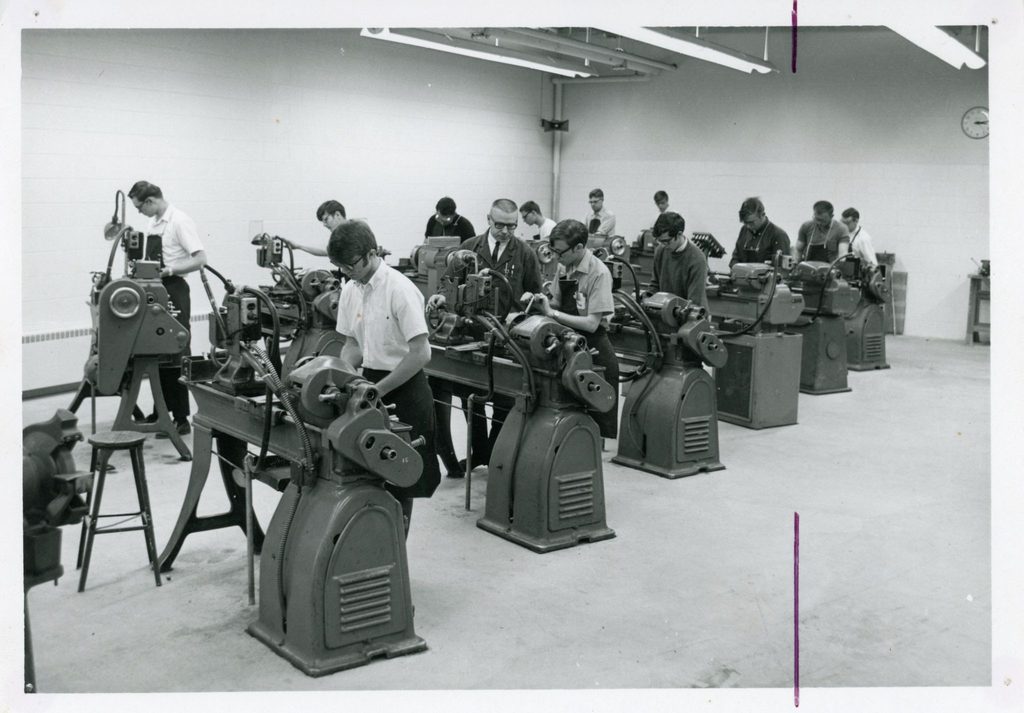
As I processed the collection, I wasn’t sure what to do with these sorts of images. Traditional research would be time-consuming, and I only had 120 hours allotted to this project. Yet, we wanted to strike that elusive balance between quality and quantity for the collection. Luckily, when I mentioned this problem to the team, Katie Aldrich, the Student Outreach and Acquisitions Specialist at the NTC Library, offered a simple, exciting idea: why not ask our faculty?
With this idea in mind, I started to plan out a workflow that would take place over the last few weeks of my time in Wausau. First, I needed to review the images I had already processed and flag the troublesome ones. Then, I organized the images into subject areas, like laser technology, welding, auto body repair, etc. With Katie’s help, I researched NTC’s departmental structure and reached out to several departments over email, hoping to set up a series of short meetings. After a meeting was scheduled, I created a separate folder with copies of each department’s images, as well as a separate copy of the metadata spreadsheet. This way, the faculty member simply showed up, scrolled through a series of images, and described them to me as I actively wrote everything down and asked further questions as needed. Afterwards, I would formalize my notes and migrate the new details into the official metadata spreadsheet.
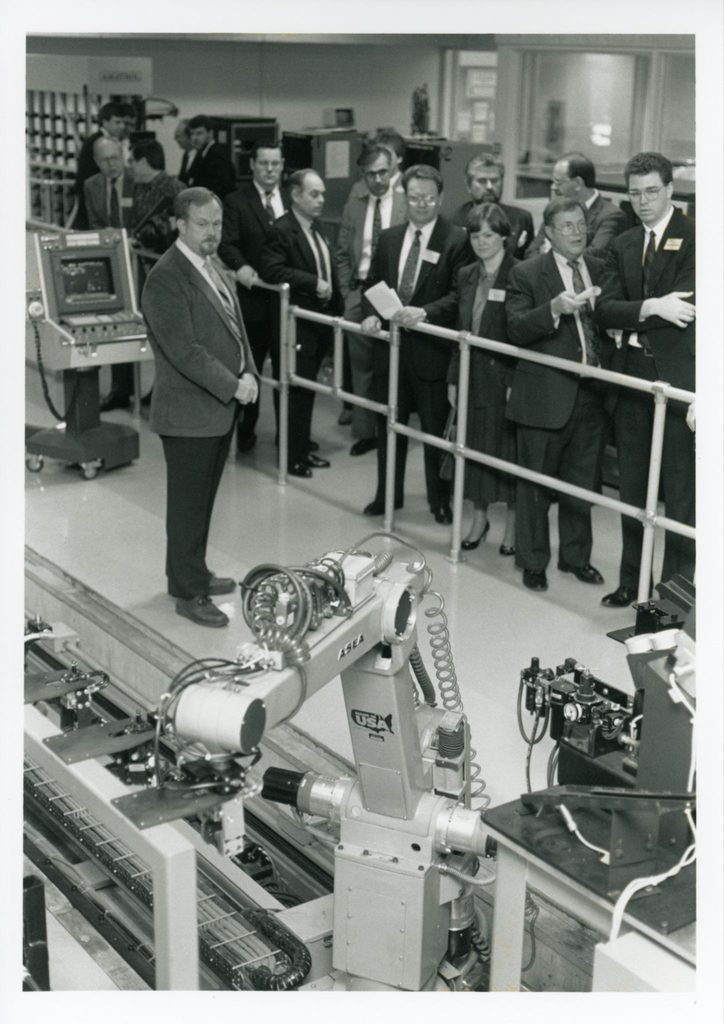
We did encounter a few issues, mainly due to the fact that I was working during the Summer semester, so we got fewer responses than we may have otherwise received. Another unanticipated hurdle was that many images had captions on the back that did not actually correspond with their subject matter. For instance, an image might be labeled “Welding,” but the correct department actually was Machine Tooling. This meant that some images were sometimes unrelated to the faculty member’s field of study and would have to be reclassified after the meeting.
However, on the whole, I was very proud of how this work turned out. For faculty, it was a low-effort meeting that required little time commitment, and they were able to provide helpful information for the majority of images I had selected.
My thanks especially go to Zach Knetter (Auto Body; Auto Repair; Agricultural Mechanics) and Daniel Grabko (Welding) for their invaluable help. For me, it required a bit of administrative planning and coordination, but the results paid dividends — our collection became much more robust, and we got to introduce faculty to the NTC Archives. We hope that these relationships will continue to strengthen over time!
My work this summer provided a helpful reminder that as we seek to document and protect our communities’ histories, their own expertise will always be an invaluable source of information.
If you’d like to hear a bit more about the general scope of my project, check out this video! It’s an adapted version of a presentation I gave to the NTC team on my final day.


You must be logged in to post a comment.